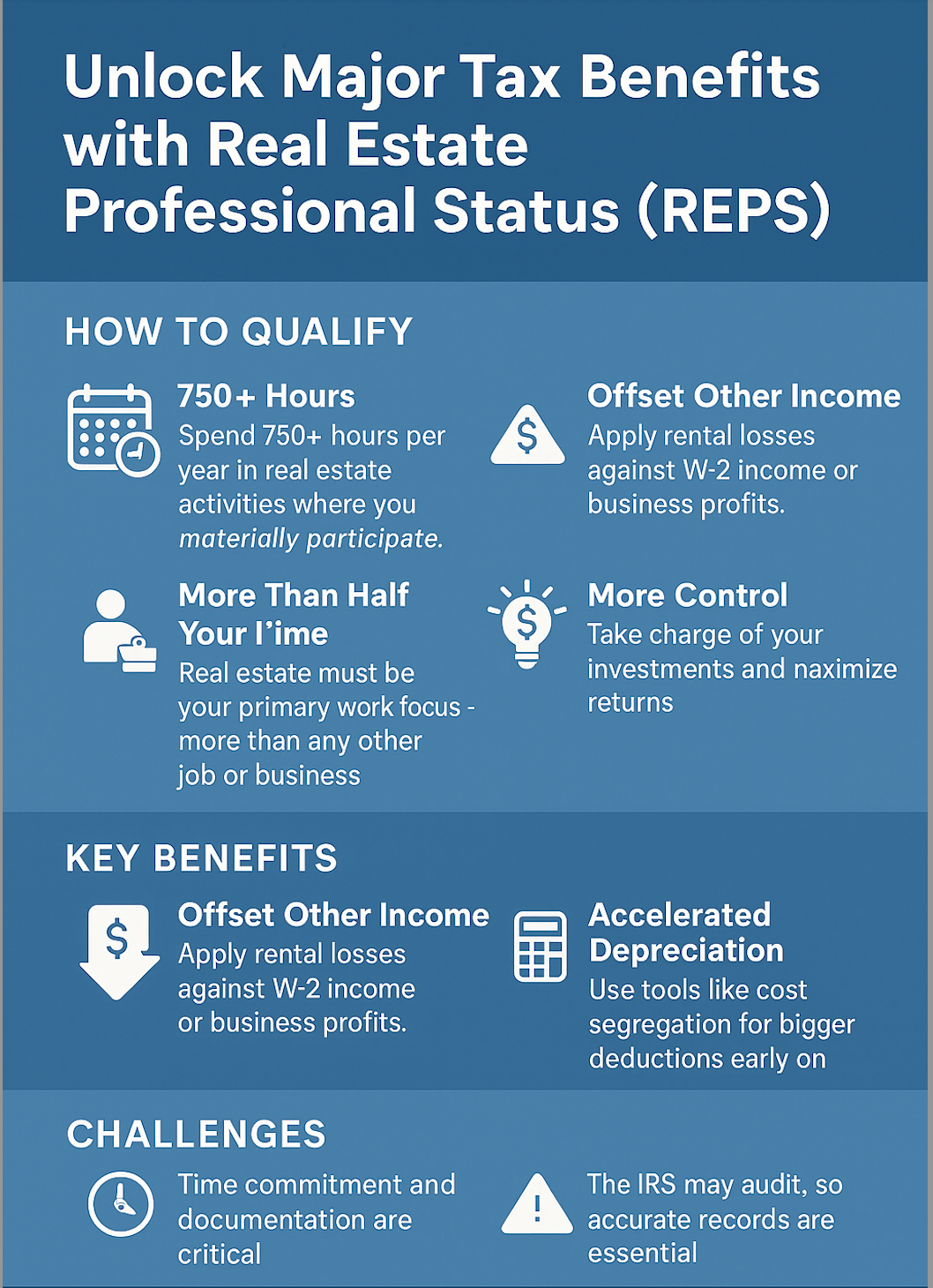
WHAT IS REAL ESTATE PROFESSIONAL STATUS (REPS)?
For real estate investors, qualifying for Real Estate Professional Status (REPS) can lead to major tax advantages. Recognized by the IRS, this designation allows eligible investors to use rental losses to offset other types of income, significantly lowering their overall tax liability. However, qualifying requires a clear understanding of specific rules and a strong commitment to meeting them. This guide breaks down what it takes to qualify—and why it’s worth it.
What Is Real Estate Professional Status (REPS)?
REPS was created to reward active real estate investors with favorable tax treatment. Unlike passive investors, those who qualify can use rental losses to offset non-passive income like W-2 wages, business income, or capital gains.
To qualify, you must meet two key time-based requirements:
1. 750-Hour Rule
You must spend more than 750 hours during the tax year in real estate activities where you materially participate—this includes tasks like managing properties, meeting with tenants, and overseeing maintenance.
2. More Than Half Your Working Time
More than 50% of the time you spend working during the year must be devoted to real estate trades or businesses. If you have another full-time job, this requirement can be challenging.
What Is Material Participation?
Material participation means you’re consistently and meaningfully involved in your real estate activities. You must pass at least one of several IRS-defined tests, such as:
Participating over 500 hours in the activity during the year
Doing most of the work yourself
Spending more than 100 hours, provided no one else spends more time than you
Demonstrating regular, continuous, and substantial involvement based on facts and circumstances
Key Benefits of REPS
Offset Non-Passive Income
REPS allows you to apply rental losses against other types of income, which can drastically reduce your tax bill. Losses may come from mortgage interest, property management expenses, maintenance, and depreciation.
Accelerated Depreciation
You can leverage strategies like cost segregation to accelerate depreciation and front-load deductions, improving cash flow in the early years of property ownership.
Active Involvement
Being classified as a real estate professional means you have direct control over your investments, helping you make better decisions and increase profitability—while maximizing tax benefits.
Challenges to Qualifying
Time Commitment
Reaching the 750-hour threshold and dedicating over half your work time to real estate can be tough if you have another job or business.
Detailed Record-Keeping
You’ll need to maintain clear, accurate logs of time spent on real estate tasks, including dates, activities, and hours—essential for IRS compliance.
IRS Scrutiny
Because of the substantial tax breaks REPS offers, the IRS often audits claims. Solid documentation and a sound understanding of the requirements are essential.
How to Qualify as a Real Estate Professional
Track Your Time: Keep a detailed log of all real estate-related activities, including dates and hours.
Be Actively Involved: Regularly manage operations—oversee repairs, handle tenant issues, review financials.
Separate Business Activities: Clearly distinguish real estate hours from time spent in any other profession.
Ensure Material Participation: Focus on activities that demand your regular and meaningful involvement.
Consult a Tax Expert: Partner with a tax professional who specializes in real estate to guide you through the process and help you optimize your deductions.
Final Thoughts
Real Estate Professional Status can be a powerful tax strategy for serious investors. While it requires time, effort, and detailed documentation, the financial rewards can be significant. By understanding the criteria and working with experienced professionals, you can take full advantage of REPS and improve the overall return on your investments.
SAMPLE WEEKLY SCHEDULE
To meet the 750-hour requirement over a 12-month period, you’ll need to average approximately 14.5 hours per week. Below is a sample weekly schedule illustrating how you might allocate your time across various qualifying activities:
Weekly Schedule
• Monday
• 9:00 AM – 11:00 AM (2 hours): Property management tasks (e.g., coordinating maintenance, addressing tenant inquiries).
• 11:30 AM – 1:00 PM (1.5 hours): Researching market trends and analyzing potential investment opportunities.
• Tuesday
• 10:00 AM – 12:00 PM (2 hours): Property showings and meeting with prospective tenants or buyers.
• 1:00 PM – 2:30 PM (1.5 hours): Networking with real estate professionals and attending industry events.
• Wednesday
• 9:00 AM – 11:00 AM (2 hours): Overseeing property renovations or improvements.
• 11:30 AM – 1:00 PM (1.5 hours): Updating property listings and marketing efforts.
• Thursday
• 10:00 AM – 12:00 PM (2 hours): Reviewing and managing financial records related to your properties.
• 1:00 PM – 2:30 PM (1.5 hours): Meeting with contractors and service providers.
• Friday
• 9:00 AM – 11:00 AM (2 hours): Conducting property inspections and ensuring compliance with regulations.
• 11:30 AM – 1:00 PM (1.5 hours): Engaging in tenant relations and lease management.
• Saturday
• 10:00 AM – 12:00 PM (2 hours): Continuing education courses or workshops related to real estate.
Total Weekly Hours: 15 hours
This schedule totals 15 hours per week, slightly exceeding the average required to meet the 750-hour annual threshold. Adjustments can be made based on your specific commitments and the nature of your real estate activities.
Qualifying Activities
The IRS recognizes a range of activities that count toward the 750-hour requirement, including:
• Property Acquisition: Time spent identifying, evaluating, and purchasing properties.
• Property Management: Overseeing day-to-day operations, such as tenant communications and maintenance coordination.
• Renovation and Development: Managing construction, remodeling, or property improvement projects.
• Market Research: Analyzing market trends, scouting potential investment opportunities, and studying economic factors affecting real estate.
• Leasing Activities: Advertising properties, conducting showings, and negotiating lease agreements.
• Brokerage Services: Facilitating property sales or purchases as a licensed real estate broker.
Non-Qualifying Activities
Certain activities do not count toward the 750-hour requirement:
• Travel Time: Commuting to and from properties or meetings.
• On-Call Time: Being available without actively performing tasks.
• Educational Pursuits: Studying for real estate exams or general education not directly related to active participation.
Documentation and Compliance
Maintaining detailed records is crucial to substantiate your real estate professional status:
• Time Logs: Keep contemporaneous logs detailing dates, hours worked, and descriptions of activities performed.
• Supporting Documents: Retain emails, contracts, invoices, and other evidence corroborating your participation.
Accurate documentation will support your eligibility and compliance with IRS requirements.